On November 7, Japanese Prime Minister Sanae Takaichi declared in parliament that an attack on Taiwan by China’s People’s Liberation Army (PLA) would create “a situation threatening Japan’s survival.” She has made overt what Japanese diplomats, intelligence officials and military officers have hitherto said in private: Japan could intervene militarily if China invades Taiwan, exercising “collective self-defense.”
Our Japanese sources are worried about the increase in China’s defense budget and military capabilities, as well as Beijing’s growing aggression toward its neighbors. Their worries have been confirmed by China’s furious reaction to Takaichi’s speech. Beijing has demanded that Japan “fully repent for its war crimes” and “stop playing with fire on the Taiwan question.” Note that this over-the-top reaction comes after almost two years of deteriorating relations:

The Chinese Communist Party (CCP) has launched a global diplomatic campaign against Japan. Beijing is also putting immense economic pressure on Tokyo to hurt Japanese businesses and taxpayers. The tensions have escalated to limited military actions, which are short of clashes but are increasingly dangerous.
Diplomatically, China is painting Japan as an aggressor. They point to Japan’s brutal colonization of Taiwan and parts of China as evidence of mala fide intentions. The CCP is peddling the narrative that Takaichi is an aggressive nationalist who aims to undermine Chinese sovereignty. They also paint her to be an unqualified, inexperienced and irresponsible leader. This Chinese narrative seeks to weaken Takaichi’s ability to govern Japan and damage her international reputation.
In a now-deleted social media post, a Chinese diplomat in Osaka commented that“the dirty neck that sticks itself in must be cut off.”This post was seemingly directed at Takaichi, as the post was linked to a news article on the prime minister’s Taiwan remarks. The various arms of the Chinese government have been singing in one chorus condemning Takaichi for launching a new era of aggressive Japanese nationalism. Foreign Minister Wang Yi’s claim that Japan has crossed a red line and that all countries have the responsibility to “prevent the resurgence of Japanese militarism” has upped the diplomatic ante.
FOI Senior Partner Glenn Carle, a retired CIA officer who now advises companies, governments and organizations on geopolitical risk, believes China’s diplomatic outrage to be “a tempest in a Beijing-made teapot.” He points that China has been pushing nearly all its Asian neighbors around, notably in the South and East China Seas. Most recently, the PLA conducted large-scale military exercises against Taiwan at the end of 2025. In a threatening two-day exercise, the PLA simulated a blockade of Taiwan for the second time in the year, increasing anxieties in both Taipei and Tokyo.
Carle holds that this bullying of neighbors, other states and even foreign citizens who do not adhere to the CCP party line makes Japan rightly nervous. He argues that Beijing’s constant refrains to historic wrongs and use of the “Japanese militarism” card is self-serving, hypocritical and dishonest. The CCP uses this narrative cynically, often to divert attention from a domestic problem or to put pressure on Japan. Carle believes that Beijing damning Tokyo is akin to “blaming the person being bullied for going to the gym to get in shape so that he can stand up better to bullying in the future.”
Undeterred by such concerns, Beijing is tooting its diplomatic horn as loudly as it can. In a large-scale coordinated campaign, China has sent two letters to the UN criticizing Japan, accusing it of threatening “an armed intervention” over Taiwan and conducting “a grave violation of international law.” Beijing has also leaned on Russia and North Korea to publicly denounce Japan. China is also signaling South Korea’s claim to the Takeshima/Dokdo islets, which is disputed by Japan.
Analysts suggest that Beijing has also managed to come to some form of a backroom deal with Washington, which has led to the absence of high-level backing for Takaichi. Notably, the Japanese feel some angst over the lack of a forceful statement from the White House. Secretary of State Marco Rubio’s delicate balancing act — he has said that the US will find ways to work with China without undermining Washington’s security commitments to Japan — has not reassured Tokyo.
Tensions between the two nations are at a high point. China is not only turning the diplomatic ratchet but is also using economic leverage and military maneuvers to pressure Japan to backtrack.
Tensions go beyond diplomacy
Beijing has issued an advisory to its citizens against traveling to Japan. This has reduced the number of Chinese tourists to Japan. Sales of goods and services have suffered. Over the last few years, Chinese shoppers have provided a big boost to the Japanese economy. Now, department stores and the retail industry are hurting. Hotels have suffered from cancellations. From January to November, tourists from Mainland China and Hong Kong accounted for 28% of all tourists to Japan. The number of Chinese tourists during this period grew by 37.5% since last year.
Recently, Japan has emerged as a key destination for Chinese students. Not only do they come to study at universities in Tokyo and Osaka, but they also flock to private boarding schools. Rugby School Japan (RSJ) and Harrow International School Appi are two examples of posh destinations for rich Chinese students. The CCP has asked Chinese students to reconsider studying in Japan, hurting a growing sector of the Japanese economy.
China has also reinstated a de facto import ban on Japanese seafood. After the Fukushima nuclear disaster, Beijing imposed this ban on August 24, 2023, and only lifted it in July of this year. Although Japanese exports achieved a record in 2024, the lack of Chinese demand has slowed their growth. China is a valuable export market for Japan, and Beijing’s ban hurts Japanese exporters.
China has also postponed Japanese film releases and canceled cultural events. Demon Slayer: Kimetsu no Yaiba — Infinity Castle, a Japanese anime, was China’s top-grossing foreign film of the year. China is the second-largest cinema market in the world, and Japanese anime has enjoyed a breakout year in this market in 2025. Now, six Japanese anime productions, which would have been otherwise released, find themselves in cold storage. Japanese cultural performances such as concerts and anime events have been gaining in popularity in China. They are also on hold.
Notably, China has not yet restricted rare earth exports to Japan this year as it did with the US earlier in 2025. Most other Chinese products are still coming to Japanese markets as well. In earlier crises, Beijing called for boycotts of Japanese products. This time, it has not. In private, Chinese officials have been assuaging concerns of Japanese executives running their operations in China.
Yet Japanese investor confidence has been falling in recent years. According to Japan’s Ministry of Finance, the country’s net foreign direct investment into mainland China fell by 30.6% in the first three quarters of 2023, reaching the lowest amount since the data series began. That year, in a poll by the Japanese Chamber of Commerce in China, only 10% of the 8,300 firms surveyed said they planned to increase investments. Our business sources in Tokyo confirm this trend. China-Japan trade relations have suffered because of the latest crisis, but tensions have been increasing in recent years.
Both nations ramped up military actions, but there are limits
Military maneuvers have caused greater concern. On December 11, two American B-52 bombers flew with Japanese fighters over the Sea of Japan. That very day, US Defense Secretary Pete Hegseth and Japanese Defense Minister Shinjirō Koizumi underscored their commitment to deterring aggression in the Asia-Pacific in a call and reaffirmed the US-Japan Alliance.
This followed an alarming incident on the first weekend of December when Chinese J-15 fighter jets twice locked radar targets on Japanese F-15 fighters. The Japanese jets were monitoring the People’s Liberation Army Navy aircraft carrier CNS Liaoning in international waters near Japan’s Okinawa Islands.
In addition, two Russian Tu-95 nuclear-capable strategic bombers flew from the Sea of Japan toward the East China Sea to rendezvous with two Chinese H-6 bombers. The Russian and Chinese bombers performed a “long-distance joint flight” in the Pacific. Four Chinese J-16 fighter jets joined them “as they made a round-trip flight between Japan’s Okinawa and Miyako islands.” The Miyako Strait between the two islands is classified as international waters, but a joint Russian-Chinese operation here is seen by Tokyo as highly provocative. Japan also detected simultaneous Russian air force activity in the Sea of Japan, consisting of one early-warning aircraft A-50 and two Su-30 fighters. Clearly, Beijing has decided to increase pressure on Tokyo and has the support of Moscow to do so.
Our sources in China, not only in the government but also in the private sector, suspect Japan plans to remilitarize. They fear Japanese military support for Taiwan and Tokyo strengthening claims on disputed islands. They also fear the Japanese military fortifying positions in islands currently under its control, such as the Senkaku Islands and the Yonaguni Island. Yonaguni marks the tail end of an archipelago stretching north to Japan’s main islands. Since Speaker of the House of Representatives Nancy Pelosi visited Taipei in 2022, China has increased the pressure on Taiwan and strenuously objected to Japanese plans for Yonaguni.
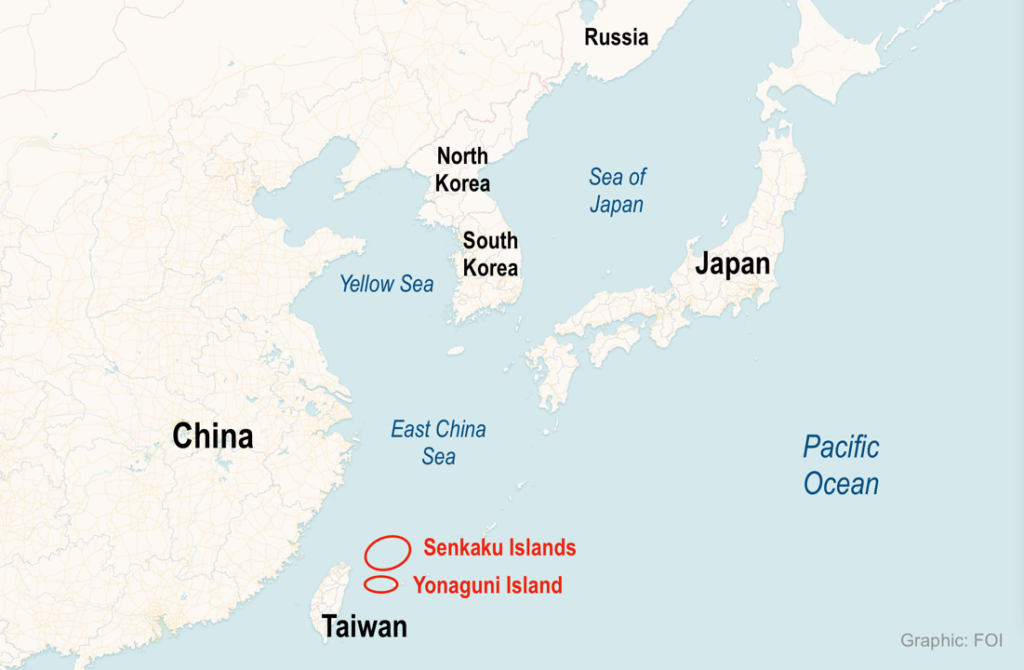
The Japan Times tells us that “up and down the 160-strong Ryukyu island chain, Japan is putting in place missile batteries, radar towers, ammunition storage sites and other combat facilities.” Tokyo is also deploying major military assets on Kyushu, the southernmost of Japan’s four main islands. These include F-35 fighter jets and long-range missiles. Tokyo is also increasing the presence of the Amphibious Rapid Deployment Brigade, Japan’s version of the US Marine Corps.
Chinese suspicions about Japan’s intentions are also fed by Tokyo’s rapid increase in defense spending. In 1976, Prime Minister Miki Takeo capped Japan’s defense spending at 1% of GNP. In 1987, Prime Minister Nakasone Yasuhiro abolished this official limit but Japan did not cross the 1% mark for decades. In December 2022, Prime Minister Kishida Fumio announced Japan would increase its defense budget from 1% to 2% by the 2027 fiscal year. To Chinese eyes, Japan is abandoning its postwar pacifism and embracing militarism again. However, it is important to remember that the increase in the Japanese budget has occurred over a period when the yen has depreciated substantially against the dollar. While the Japanese have been able to increase purchases of domestic weapons, higher budgets have not translated into proportionately more US arms:
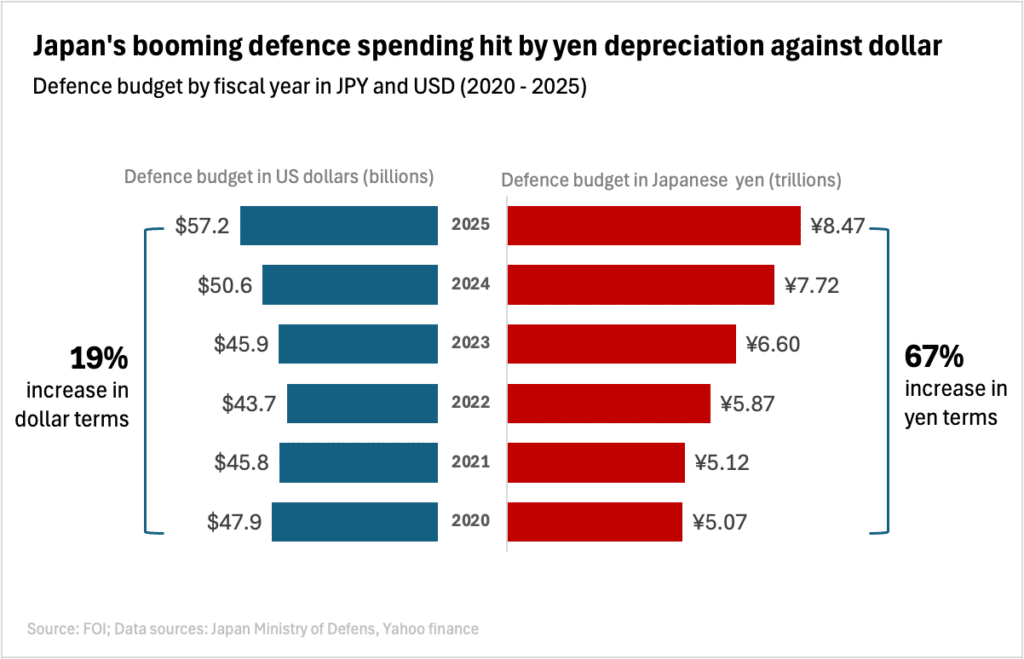
Yet despite higher defence spending, demography and politics mean Japan faces barriers to military development. In common with Germany, Japan is a major country looking to build a realistic military capability to face a larger potential adversary. Both have shrinking native populations and more attractive civilian opportunities for potential recruits. The Japan Self-Defense Forces regularly fall short of recruitment goals, often by 50%. Technology cannot, at present, fully compensate for major shortfalls in personnel.
Politically, Japanese leaders are becoming increasingly concerned about their reliance upon the US for defence needs. Our military sources in Tokyo share that a growing segment of these leaders expect Japan to become more capable of and more willing to engage in military actions without US support.
Even if recruitment shortfalls are overcome, and disquiet over US reliability wanes, military strength now requires advanced capabilities that remain in short supply in Japan. Just as in Germany, there are not enough skilled personnel in AI and machine learning, cybersecurity, data analytics and cloud computing. Indeed, Japan faces a general shortage of IT skills: In 2021, the Ministry of Economy, Trade and Industry (METI) reported a deficit of 220,000 IT personnel in 2018, rising to 790,000 by 2030. Japan simply does not have enough people, including those with much-needed skillsets, to prosecute a major war.
In a nutshell, China’s real and imagined fears about Japanese remilitarization are grossly exaggerated. Note that Beijing’s own defense spending has increased 13-fold in 30 years. The Center for Strategic and International Studies points out that China’s official defense spending was nearly $247 billion in 2025, but other estimates are much higher. One study places this figure to be $471 billion. More importantly, China has manufacturing muscle. Its navy, air force and missiles have expanded dramatically. China has dual-use satellites and technologies, and can churn out drones by the millions as well. Some analysts even argue that China is a more powerful version of pre-World War II Japan. Unsurprisingly, as Carle points out, Tokyo is hitting the military gym.
The dark shadow of history
Even though China has emerged as a global superpower, it still carries burning resentments. Our Chinese sources constantly point out that Taiwan was Japan’s first colony and Tokyo ruled the island for 50 years until the end of World War II. Imperial Japan beat Qing China in the First Sino-Japanese War, which ended with the 1895 Treaty of Shimonoseki. This inaugurated the era of Nanshin-ron, the Southern Expansion Strategy, which held that Southeast Asia and the Pacific Islands were Japan’s sphere of influence. Similar to the 1823 Monroe Doctrine that regarded Latin America as lying in the US sphere of influence, Nanshin-ron led to the creation and then expansion of the Japanese empire in Asia.
Imperial Japan tried to turn Taiwan into a showpiece “model colony,” establishing order, eradicating disease, building infrastructure and creating a modern economy. Thanks to these efforts, “Taiwan soon became the most-advanced place in East Asia outside Japan itself.” On the flip side, the Japanese ruthlessly crushed local rebellions and forced the Taiwanese to learn Japanese as well as absorb Japanese culture. Nevertheless, many of our Taiwanese sources say that Taiwan’s experience of Japanese rule was much better than the experience of their Chinese relatives in the 1950s and 1960s under the CCP.
In Mainland China, many still harbor bitter memories of the period of Japanese imperial expansion after Japan’s 1931 invasion of Manchuria. On December 13, the CCP conducted an annual national memorial ceremony — this began in 2014 after Chinese President Xi Jinping came to power and inaugurated a period of more aggressive nationalism — for the victims of the Nanjing Massacre. In 1937, 88 years ago, Japanese troops infamously tortured, looted, raped and killed 100,000 to 200,000 Chinese civilians, which the country remembers to this day.
China is also emotional about another seemingly trivial and largely symbolic issue. Our Chinese sources are unhappy with Japanese leaders visiting Yasukuni Shrine. This shrine honors about 2.46 million people who died in wars from the late Edo period (1800s to 1868) to World War II. Of these, 14 were held to be “Class A war criminals” by victorious allies. They were enshrined in 1978, kicking off a diplomatic and political controversy that rages to this day. Takaichi is a nationalist who has regularly paid respects at Yasukuni in the past. Koizumi, her defense minister, admitted, “It’s true I have paid respect there every year on the anniversary of the end of the war.” As you can expect, this has kicked off a furor in Chinese nationalist circles.
Our Japanese sources are tired of China’s constant harping on the past. They politely point out that the CCP conveniently forgets the tens of millions who died in Mao Zedong’s catastrophic Great Leap Forward and the complete chaos of the Cultural Revolution. Since World War II, Japan has abided by its US-imposed pacifist constitution, invested hugely in China and funded development schemes around the world, especially in the Global South. Note that Japan is still the third-largest financial contributor to the UN.
Besides, the Japanese think that the CCP is using history as a weapon to cut the nationalist Takaichi down to size at the very start of her prime ministership. An examination of Japan’s recent history vindicates their argument. Shinzo Abe, Takaichi’s political godfather and Japan’s longest-serving prime minister, warned Beijing that attacking Taiwan would be “economic suicide.” In a virtual keynote on December 1, 2021, Abe said, “A Taiwan contingency is a Japanese contingency, and therefore a contingency for the Japan-U.S. alliance.”
When he made the speech, Abe was no longer prime minister, but he was still the leading light of the ruling Liberal Democratic Party (LDP). He was echoing the 1972 US-China Joint Communiqué, also known as the Shanghai Communiqué, which adopted a “One China” policy and called for “a peaceful settlement of the Taiwan question.” In the communiqué, both the US and China agreed that “international disputes should be settled on this basis, without resorting to the use or threat of force.” That is precisely what Abe and Takaichi want in relation to Taiwan.
Note that other Japanese politicians have also taken a similar view to Abe’s. In 2021, Nobuo Kishi, the then defense minister, claimed, “The peace and stability of Taiwan are directly connected to Japan.” The same year, his LDP colleague Tarō Asō, the then deputy prime minister, said, “If a major problem took place in Taiwan, it would not be too much to say that it could relate to a survival-threatening situation” for Japan. After the Russian invasion of Ukraine in 2022, Kishida, prime minister from October 2021 to October 2024, repeatedly asserted that “Ukraine today may be East Asia tomorrow,” which was clearly alluding to a potential Chinese invasion of Taiwan. Takaichi is not as out of line with her Japanese predecessors as the CCP propaganda and Chinese nationalist outrage would suggest.
Takaichi’s Taiwan remarks are viewed differently by both sides
Takaichi’s comments on Taiwan were not part of a speech or statement. She was merely responding to a question in parliament from Katsuya Okada of the Constitutional Democratic Party. The prime minister did not say that Japan would use military force to defend Taiwan or commit to any specific action in aid of Taipei in the case of a Chinese invasion. After mentioning the possibility of a “survival-threatening situation” for Japan in the case of a Taiwan contingency, Takaichi said that the Japanese government would make its judgment by synthesizing all information based on the specific circumstances of the actual situation.
Japanese diplomats painfully point out that their prime minister’s language reflects Tokyo’s consistent position on the issue. Saya Kiba, one of our Japanese authors, explains “how Japan’s strategic ambiguity, security law and US alliance constrain direct defense of Taiwan.” She points out that, while Takaichi’s explanation did not formally violate Japan’s existing Taiwan policy, it went further than previous prime ministers had dared to go in the past.
Beijing takes a different view and sees Takaichi as a potential threat. The first female prime minister of Japan is the daughter of a policeman and is perceived as a security hawk. Takaichi has positioned herself as Abe’s heir and Beijing has no love lost for the late leader who deviated “from Japan’s pacifist policies to confront China’s nationalistic designs.” Abe visited Yasukuni and fathered the Quadrilateral Security Dialogue (Quad) in 2007 to keep the Indo-Pacific “free and open”. The CCP has not forgotten or forgiven these actions.
China Daily, an English-language newspaper owned by the Central Propaganda Department of the CCP, has argued that Takaichi is hyping up the “China threat” to consolidate her right-wing political base and accelerate military expansion. In 2024, the China Institute for International Studies (CIIS) objected to the 2022 Japanese National Security Strategy that concluded its communist neighbor to be “an unprecedented and the greatest strategic challenge” to Japan. Per CIIS, Japan used these words only to rationalize and legitimize its remilitarization.
In addition, US President Donald Trump’s October visit to Japan has not gone down well with China. The dealmaker-in-chief and Takaichi agreed that Japan would invest $550 billion into American industries and pay a baseline 15% tariff rate, apart from buying energy and weapons from the US. Beijing believes that Takaichi is appeasing Trump to win American support against China.
On the other hand, Tokyo is increasingly nervous about Beijing’s increasing belligerence. Shrill nationalist condemnation in the media, diplomatic actions, economic pressure and military actions rightly make Japan anxious. The end-of-year military drills around Taiwan described earlier rightly raise security concerns in both Taipei and Taiwan. Note that Carle and this author raised the alarm about a joint Russian and Chinese fleet circumnavigating Japan’s main island of Honshu in October 2021. In our eyes, this was a watershed moment and we took the view that Tokyo would have no choice but to boost its defense. As we predicted, Japan has done so since.
Today, the stage is set for rising tensions between China and Japan. At the heart of the China-Japan dispute are two contrasting worldviews. The “One China” policy is sacred for the CCP, which views a Taiwanese declaration of independence and third-party support for Taiwan’s independence as a direct threat to China’s sovereignty. Popular opinion in China patriotically supports the CCP position on Taiwan, and Chinese rhetoric on social media is increasingly jingoistic. In contrast, Japan views Taiwan as a de facto independent state and China as an increasingly aggressive revisionist power. Also, Tokyo views a Chinese threat to Taiwan as a risk to Japan’s national security. Chinese control over Taiwan would facilitate Beijing’s ability to take over islands both China and Japan claim as their own.
China’s belligerence and Japan’s response has set into motion a chain of events that could end dangerously. Even though Japan recently reaffirmed its post-World War II pledge never to possess nuclear weapons, talk of acquiring its own nuclear deterrent is now in the public domain. This is a first since Japan surrendered to the US after suffering the twin nuclear disasters of Hiroshima and Nagasaki. Japanese leaders seem to be heeding the advice Carle gave them when he visited Tokyo: “Hold America as close as possible, but Japan should count only on itself.”
As a result, East Asia is increasingly dangerous. Both Japan and China are quietly preparing for a potential armed conflict. A slight misjudgment, miscalculation or misstep by leaders in Beijing or Tokyo, or even a pilot or sailor, could lead to far-reaching global consequences.
[Cheyenne Torres assisted the author in researching for and editing this article.]
The views expressed in this article are the author’s own and do not necessarily reflect Fair Observer’s editorial policy.
The post China-Japan Tensions Rise to Highest Levels Since World War II appeared first on Fair Observer.
from Fair Observer https://ift.tt/MEhokqr




0 Comments